Gerard's Herbal - Part 3
|
|
|
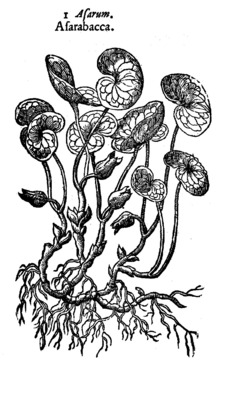
| Fig. 1242. Asarabacca (1) |
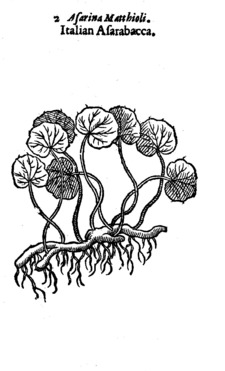
Fig. 1243. Italian Asarabacca (2) |
The Description
The leaves of Asarabacca are smooth, of a deep green colour, rounder, broader, and tenderer than those of Ivy, and not cornered at all, not unlike to those of Sow-Bread: the flowers lie close to the roots, hid under the leaves, standing upon slender footstalks, of an ill-favoured purple colour, like to the flowers and husks of Henbane, but less, wherein are contained small seeds, cornered, and somewhat rough: the roots are many, small and slender, growing aslope under the upper crust of the earth, one folded within another, of an unpleasant taste, but of a most sweet and pleasing smell, having withal a kind of biting quality.
2. This strange kind of Asarabacca, which Matthiolus hath set forth creeping on the ground; in manner of our common Asarabacca, hath leaves somewhat rounder and rougher, slightly indented about the edges, and set upon long slender footstalks: the flowers grow hard unto the ground like unto those of Camomile, but much lesser, of a mealy or dusty colour, and not without smell. The roots are long and slender, creeping under the upper crust of the earth, of a sharp taste, and bitter withal.
The Place.
It delighteth to grow in shadowy places, and is very common in most gardens.
The Time.
The herb is always green; yet doth it in the spring bring forth new leaves and flowers.
The Names.
It is called in Greek Asarum: in Latin, Nardus rustica: and of divers, Perpensa: Perpensa is also Baccharis in Pliny, lib. 21, cap. 21. Macer saith, That Asarum is called Vulgago, in these words:
Est Asaron Græce, Vulgago dicta Latine
This herb, Asaron do the Grecians name;
Whereas the Latins Vulgago clepe the same.
It is found also amongst the bastard names, that it was called of the great learned Philosophers Martis sanguinis, or the blood of Mars: and of the French men Baccar; and thereupon it seemeth that the word Asarabacca came, which the apothecaries use, and likewise the common people: but there is another Baccharis differing from Asarum, yet notwithstanding Crateuas doth also call Baccharis, Asarum.
This confusion of hath the names hath been the cause, that most could not sufficiently expound themselves concerning Asarum and Baccharis; and that many things have been written amiss in many copies of Dioscorides, in the chapter of Asarum: for when it is set down in the Greek copies a sweet smelling garden herb, it belongeth not to the description of this Asarum, but to that of Baccharis: for Asarum (as Pliny saith) is so called, because it is not put into garlands: and so by that means it came to pass, that oftentimes the descriptions of the old writers were found corrupted and confused: which thing; as it is in this place manifest, so oftentimes it cannot so easily be marked in other places. Furthermore, Asarum is called in French Cabaret: in High Dutch, Hazelwurtz: in Low Dutch, Mansooren: in English, Asarabacca, Foalfoot, and Hazel-Wort.
The Temperature.
The leaves of Asarabacca are hot and dry, with a purging quality adjoined thereunto, yet not without a certain kind of astriction or binding. The roots are also hot and dry, yet more than the leaves; they are of thin and subtle parts: they procure urine, bring down the desired sickness, and are like in faculty, as Galen saith, to the roots of Acorus, but yet more forceable; and the roots of Acorus are also of a thin essence, heating, attenuating, drying, and provoking urine, as he affirmeth: which things are happily performed by taking the roots of Asarabacca, either by themselves, or mixed with other things.
The Virtues.
A. The leaves draw forth by vomit, thick phlegrnatic and choleric humours, and withal move the belly; and in this they are more forceable and of greater effect than the roots themselves.
B. They are thought to keep in hard swelling cankers that they increase not, or come to exulceration, or creeping any farther if they be outwardly applied upon the same.
C. The roots are good against the stoppings of the liver, gall, and spleen, against wens and hard swellings, and agues of long continuance: but being taken in the greater quantity, they purge phlegm and choler not much less than the leaves (though Galen say no) by vomit especially, and also by siege.
D. One dram of the powder of the roots given to drink in ale or wine, grossly beaten, provoketh vomit for the purposes aforesaid; but being beaten into fine powder, and so given it purgeth very little by vomit, but worketh most by procuring much urine; therefore the grosser the powder is, so much the better.
E. But if the roots be infused or boiled, then must two, three, or four drams be put to the infusion; and of the leaves eight or nine be sufficient: the juice of which stamped with some liquid thing, is to be given. The roots may be steeped in wine, but more effectually in whey or honeyed water, as Mesues teacheth.
F. The same is good for them that are tormented with the sciatica or gout in the huckle bones, for those that have the dropsy, and for such also as are vexed with a quartan ague, who are cured and made whole by vomiting.